


Maternity Care: Where to Give Birth in Yorkshire?

Updated: Oct 26

Which Hospital Trust is right for you?
Deciding which hospital trust to choose when you are pregnant is an important choice to make. All hospital's are different and the care they can provide for you during pregnancy and birth is different too. Therefore thinking about the kind of birth that you would like and finding out if that maternity hospital will support your decisions, is essential. If your options and choices aren't supported during pregnancy and birth, this could really change the outcome of your birth experience.
Research which maternity unit will give you the kind of care, facilities and options that you are looking for. If you are planning to birth out of guidance, will that hospital trust support your decision? You might be looking for a local maternity unit that offers a midwife led birth centre, which is alongside or connected to the hospital. You might be looking for a hospital Trust that supports a home birth after a caesarean section. (HBAC) or a maternity unit that has a good record of women having successful vaginal births after caesareans (VBACs).
How much do you know about Leeds Maternity, Calderdale & Huddersfield, Harrogate Maternity Unit, Airedale Maternity, Pinderfields and The Bronte Centre?
In Yorkshire, there are a variety of hospital trusts where you can birth your baby at. Understanding what they can offer you, can really help you to decide what is importnat to you.
If birthing at a birth centre that is alongside or connected to the hospital's obsteric unit is something that interests you, Leeds maternity LGI hospital, Pinderfields hospital and Calderdale birth centre can give you this option.
Maybe you would like a freestanding birth centre that feels like giving birth in a spa rather than in a clinical environment. If this sounds like you, then you might want to check out the Bronte Birth Centre in Dewsbury, which is under Mid Yorkshire Hospital Trust.
You can birth your baby wherever you choose and it doesn't matter if you are already booked under a particular maternity trust. Transferring your care is easy.
Birth Choices
Deciding where to give birth is a really important decision. Giving birth can be a magical and transformative experience for a lot of people and as you start to explore your options, you will discover that there are many birth choices available to you. The support that you receive during pregnancy and birth can make a significant difference on how your birth can unfold and how you view your birth experience later.
When you discover that you are pregnant, not only will you need to decide where to have your baby, but it is also worth thinking about how you'd like to birth your baby and what birth experience you would like to have.
It is worth thinking about the room environment, what support people you'd like to have in the room with you. If you would like any medication or pain relief during labour. If you would prefer a physiological birth or one that involves intervention and assistance during labour. It's not just about saying yes or no to these things, but more about understanding why you would or wouldn't want them. Making an informed decision and understanding the risks and benefits for you as an individual.
There's a lot to think about when you are expecting a baby, but making time to fully prepare for birth during pregnancy, will make a huge difference to how you feel long term. Having the support of a Doula can be really beneficial during pregnancy and birth and a Doula can help you to understand your options, birth choices and help you to make informed decisions. A doula helps to take the weight off the shoulders of a family, makes decision making easier and walks alongside a family as they try to navigate this life changing experience and complicated maternity system.
Where to receive Maternity Care?
One very key thing to consider when thinking about where to give birth, is which hospital trust you would like to receive your maternity care from. Now, not everybody wants medical care when giving birth and you can decide not to receive any medical care at all and that is entirely your choice. Like with all these decisions, every decision is your decision and that's why it is important to be able to make informed decisions that are right for you and your baby. However, if you do decide to receive maternity care from a local hospital Trust, which one would be right for you? Remember that you can give birth anywhere that YOU want to.
NHS Maternity Hospital Trusts in Yorkshire
Across Yorkshire, there are several NHS hospital Trusts providing maternity care, each with its own policies, practices, services and approaches to supporting women during pregnancy and birth. They also publish their own maternity statistics, which can give you a useful insight into the care that they provide. You can view NHS maternity statistics by hospital trust and this will give you the average yearly (August 2025 - July 2026) number of:
Labours induced
Vaginal birth without assistance
Assisted births
Planned Caesareans
Unplanned Caesareans
Taking the time to explore these differences and look at the available statistics can help you make a more informed decision about where to give birth, based on your individual needs, preferences and the kind of birth experience you hope to have.
I feel that it is important that families know about local birth statistics during pregnancy, so that it allows them to make an informed decision about their care. Allowing a pregnant person to know whether that hospital trust is likely to support them in having the birth that they desire, is a really big deal. If 80% of women are induced at X hospital and you do not want your labour inducing, you are probably best to avoid that hospital. However, if you do not know what the birth statistics are for your chosen hospital, you cannot make an informed decision about your care.
What Is It Like to Give Birth in the UK Today?
A recent article published by Sky News (June, 2026) has provided data from across the UK to understand what it is like to give birth in the UK today. The Data and Forensics team have analysed maternity data from March 2025-March 2026. It has found that in West Yorkshire, there are more births per midwives, compared to the national average. This will be one of the reasons why maternity services are so stretched. In West Yorkshire, pregnant women are also less likely to be placed on a care plan during pregnancy, compared to the national average.
A care plan involves continuity of care. At 28 weeks of pregnancy, pregnant women should be assigned a named midwifery team that will be present for at least 70% of their future antenatal and postnatal appointments, as well as for labour itself. Although the NHS says that this should be the default model of care offered to women, it isn't usually the case. Evidence has shown us time and time again that continuity of care is more likely to increase the chances of women having positive birth experiences and safer care.
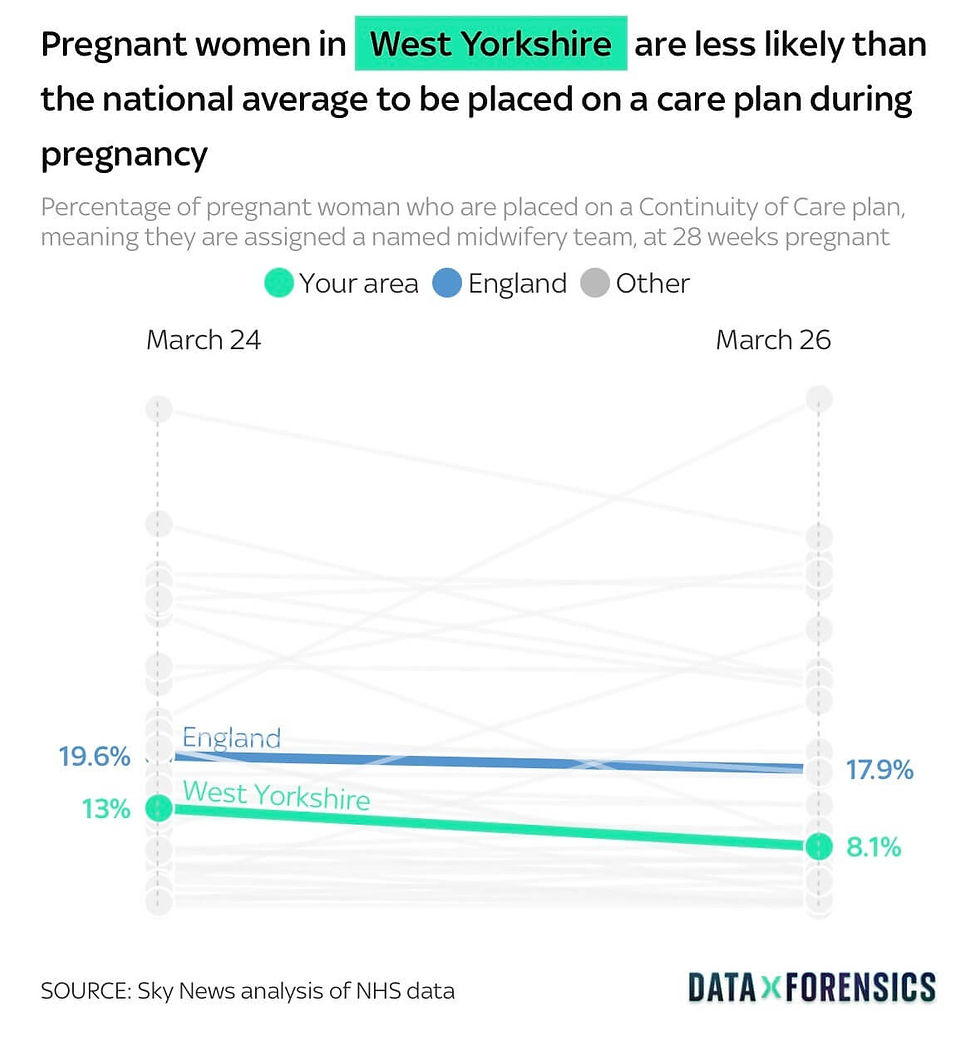
In March 2024, 13% of women within West Yorkshire were likely to be placed on a care plan compared to 19.6% in England. In March 2026, only 8.1% of women are likely to be placed on a continuity of care plan in West Yorkshire, compared with 17.9% in England. Not only has this number declined in the last two years, but in West Yorkshire, it is significantly lower than the rest of England.
Another point that is worth noting here is the number of people who have had their labours started artificially. Induction of labour is significantly higher now than it was 10 - 15 years ago, although rates have slightly fallen in recent years and this is due to more people opting for a caesarean section. Giving birth spontaneously is much rarer these days and is no longer the norm. This is a terrible shame. "Induction of labour can help healthcare providers to manage pregnancies better, particularly where there is a health concern, but many mothers explain that they felt pressured into being induced". (Dunford, D. and Boscaini-Gilroy, G., 2026).
Spontaneous labour accounts for less than half of all births now and caesarean section is partly to blame. The World Health Organisation (WHO) says that "when medically necessary, caesarean birth can be life-saving for both mother and baby. But like all major surgery, it comes with it's own risks. The WHO adds that there is no evidence to suggest that health outcomes are improved once c-section rates across a country are higher than 10%". In West Yorkshire the latest data shows that 42% of women have caesarean births, 47% have spontaneous labour and 11% have an instrumental birth involving forceps or ventouse. Compared to the rest of England, this is 3% lower for caesarean births, 3% higher for spontaneous birth and 1% higher for instrumental births. Although instrumental births can also be life-saving for mothers and babies, it can also lead to higher rates of serious birth injuries for mothers and babies and severe trauma.
When looking at the data for the number of babies in West Yorkshire who were re-admitted to hospital within 28 days of birth, we can see that this figure is slightly higher than the rest of England. From March 2025-March 2026, 6% of babies in West Yorkshire were re-admitted, compared to 5.2% in England. Reasons for being re-admitted could include infections that were missed or that families were discharged from care too early.
If you would like to take a look at other local areas and see how their figures compare, take a look at the report produced by Sky News on what it is like to give birth in the UK today.
Making Informed Decisions during pregnancy
When you decide to buy a new car, you don't usually go and buy the first car that you see. You would do some research. Maybe go for a test drive, research the reliability of the car. You would compare different makes and models, consider which cars have the equipment and features that you would like from a car. Maybe you would look at a Which? report and see which car comes out best based on various research and opinions from the experts.
It's the same with where and how to give birth. Your birth experience is a really important decision to make, much bigger than choosing a car, yet we very rarely put the same amount time and effort into preparing for birth. Somehow during pregnancy, we see materialistic items as a priority. We spend a lot of hours trying to decide which pram to buy, which car seat has the best safety rating and designing the nursery and room setup.
As much as some of these things are important, your birth preparation should be at the top of your priority list. When I work with clients, whether that's as a Doula or as a Hypnobirthing teacher, I support clients to be able to make informed decisions. The clients who do their research and become knowledgeable during pregnancy, are often those who have positive birth experiences. That doesn't mean that they always have the birth that they planned for. However, it does mean that they are able to remain in control, feel confident in the decisions that they make and feel like they had a positive experience.

West Yorkshire and Harrogate Maternity Hospitals
I have done some analysis on the monthly statistics of some of the local hospital trusts in West Yorkshire and Harrogate. Not all Yorkshire Maternity Hospital Trusts have been transparent with their birth statistics and you might wonder why this is. Leeds maternity haven't willingly produced any monthly data since May 2024. We do however know what the average last 12 month (August 2025-July 2026) statistics are for Leeds maternity, as seen below.

Barnsley Maternity Hospital have also not provided informative data, that is clear or up to date. I wanted to include Barnsley Hospital Trust in my analysis, but unfortunately Barnsley Hospital haven't been very transparent with their monthly data. Their infographic is not helpful at all. The pie chart that they've provided which shows the number of women who've had vaginal births, caesarean sections and instrumental births has no figures. This means we don't know the exact numbers. They've also not included any data on the number of inductions. You can of course take a look at Barnsley's average yearly maternity figures, including their induction rates. If we look at this number, we can see that on average they are 4% higher than England's national average induction rates and 5.6% higher than Leeds. Leeds maternity also cares for nearly 3 times as many women giving birth, compared to Barnsley.

The monthly data that we do know for Barnsley though is the number of babies born, the lightest and heaviest babies, the busiest day, (not particularly useful for birth preparation), the number of babies born in water (3% in February 2026) and the number of home births (0 in February 2026). We also don't have any up-to-date data for Barnsley Maternity Services since February 2026. This is as of October 2026, when this data was updated.
The pie chart for February 2026 however, would indicate that the majority of women (over half) either had major abdominal surgery (c-section) to birth their baby or instrumental deliveries. This is probably why the exact numbers have not been disclosed and updated. If you plan to give birth under the care of Barnsley Hospital, make sure that you ask lots of questions and fully understand your birth options and ask your midwife to provide you with recent statistics if you need to. It's important to know that you and your baby are being cared for correctly, with woman centred care and that you are given informed birth choices.
One important point to note here, is that you can make a freedom of information request. The Freedom of Information Act 2000 states that "anyone can make a request regardless of their age, nationality, or location. Requesters do not need to explain why they want the information and the freedom of information act gives everyone a legal right to access recorded information held by public authorities in England, Wales, and Northern Ireland (Scotland has its own separate legislation)."
This means that you can ask a particular NHS Hospital Trust to provide data or information about a particular concerns or query you may have. E.g. If you wanted to know how many water births have occurred at that particular hospital in the last 12 months, you can request this information.
Leeds Teaching Hospital Maternity Care and Bradford Royal Infirmary Maternity Care
You might have seen in the media lately, that 14 maternity hospital trusts across the UK are being investigated for inadequate maternity care. The BBC (2025) stated that "fourteen NHS trusts are to have their maternity services examined over what has been described as "failures in the system", the government has said."
Two of those fourteen hospital trusts in the UK are located in West Yorkshire. these include Leeds Teaching Hospital Trust and Bradford Teaching Hospital Trust. The BBC (2025) stated that "maternity services at two Leeds hospitals have been downgraded from "good" to "inadequate" by the healthcare regulator, because their failings posed "a significant risk" to women and babies.
Baroness Amos, who is leading a government-commissioned review into maternity services in England, found that "maternity services in England are failing "too many" families, with problems "at every stage" of the maternity journey." (BBC News, Feb 2026)
What Could the Nottingham Ockenden Review Recommendations mean for birth in Yorkshire & the UK?
The recent findings from the Ockenden review into maternity services in Nottingham have resulted in a number of recommendations for all NHS maternity services in England. The report follows previous investigations into serious failings at Shrewsbury and Telford Hospital NHS Trust and highlights the importance of improving safety, communication and compassionate care for women and families.
Maternity services in Leeds are already under increased scrutiny following concerns about poor outcomes for mothers and babies. As a result, Leeds Teaching Hospitals NHS Trust is expected to implement learning from both the Ockenden reviews and other national maternity investigations to improve the quality and safety of care.
On Tuesday 10th March 2026 the Secretary of State for Health and Social Care, Wes Streeting, appointed Donna Ockenden to Chair the Independent Review of maternity services at Leeds Teaching Hospitals NHS Trust. The final review of the report is due to be published in 2029 and will consider maternity and neonatal care in Leeds from January 2011 up to 31 March 2028.
Leeds Teaching Hospital Trust say "We would like to reassure families in Leeds who will be using our services currently, that significant improvements are already underway in our maternity and neonatal services, following reviews by the Care Quality Commission and NHS England. We know there is more to do, and we will continue to improve our services as we strive to ensure that every family receives safe, compassionate, inclusive, and high-quality care." (Sept, 2026).
As the Co-Chair for Leeds Maternity & Neonatal Voices Partnership, I will be visiting the different maternity departments over the coming months, across both Leeds maternity hospitals, LGI & SJUH. I will be speaking to families currently using Leeds maternity services, to see what improvements have already taken place and discover how these families have found their care and experience at Leeds.
It is highly likely that Leeds will implement some of the key recommendations from the Nottingham review. These included:
Improved fetal monitoring and lower thresholds for escalating concerns.
Enhanced bereavement support for families experiencing pregnancy or baby loss.
Listening to women throughout pregnancy and labour and taking their concerns seriously.
Better informed consent, ensuring women receive balanced information about the benefits, risks and alternatives of any proposed intervention, along with adequate time to make decisions.
Earlier escalation when labour is not progressing as expected.
More compassionate communication, including introducing staff, explaining decisions clearly, keeping families informed and offering sincere apologies when care has fallen below expected standards.
Importantly, the report also states that respectful maternity care and support for physiological birth should be balanced with timely clinical intervention when genuine concerns arise. The aim is not to increase or decrease intervention rates, but to ensure that interventions are evidence-based, clinically appropriate and made in partnership with women and their families.
As a doula and hypnobirthing teacher, one of my concerns is how these recommendations may be interpreted in practice. There is a possibility that lower thresholds for escalation could lead to more interventions, even when evidence does not clearly demonstrate improved outcomes for low-risk women.
For example, continuous cardiotocography (CTG) monitoring is recommended in many higher-risk situations and undoubtedly has an important role in identifying babies who may be compromised during labour. However, for women with uncomplicated pregnancies, research has consistently shown that continuous CTG monitoring increases the likelihood of interventions such as instrumental birth and caesarean section without reducing overall rates of perinatal mortality or cerebral palsy when compared with intermittent auscultation.
Researchers such as Dr Kirsten Small have highlighted that "intermittent auscultation with a handheld Doppler is a safe and appropriate method of fetal monitoring for many low-risk pregnancies, including many women planning a vaginal birth after caesarean (VBAC)".
The challenge for clinicians is that maternity care is, by necessity, based on assessing and managing risk. When concerns arise, healthcare professionals must decide whether the risks of intervening are outweighed by the risks of continuing with labour. These are often complex decisions made in situations where uncertainty exists. However, intervention is not automatically the safest option simply because it is available.
As the authors of Beyond too little, too late and too much, too soon: a pathway towards evidence-based, respectful maternity care worldwide published in The Lancet conclude, "optimal maternity care requires evidence-based intervention only when clinically justified because both failing to act and acting unnecessarily can cause harm".
Continuous CTG monitoring may also influence the overall birth experience. It can restrict movement, make water birth more difficult or impossible unless wireless monitoring is available, alter a woman's birth preferences and sometimes lead to further interventions following fetal heart rate abnormalities that later prove not to represent fetal compromise. A study conducted in 2020 - 2021, found that "the false positive rate of CTGs in this study was between 92 to 98%. This is the proportion of babies with an abnormal heart rate pattern who were actually fine. Another claim often made about CTG monitoring is that a normal trace is very reassuring as it shows a reduced chance that a poor outcome is possible. That was not true in the case of this study." (Dr Kirsten Small, 2026).
Although CTG is a valuable clinical tool, it is not a perfect test and should always be interpreted alongside the wider clinical picture.
Similarly, if thresholds for escalating concerns become increasingly cautious, there is a possibility that more senior obstetric involvement could occur earlier in labour. While this may improve outcomes for women and babies experiencing genuine complications, it also has the potential to increase intervention rates if physiological labour is not fully understood or allowed adequate time to progress.
For mothers and babies experiencing genuine emergencies, these recommendations are essential and have the potential to prevent avoidable harm and improve outcomes. The challenge is ensuring that every decision is individualised, evidence-based and made in partnership with the woman, rather than driven solely by fear of adverse outcomes.
How Antenatal Education & Doula Support can Improve Outcomes for Mum's and Babies
This is why high-quality antenatal education has never been more important. Understanding common medical terminology, knowing the benefits, risks and alternatives of proposed interventions, and feeling confident to ask questions can make a significant difference to your birth experience. Having a birth partner or doula, who understands your wishes and feels able to advocate for you is equally valuable.
As a doula and hypnobirthing teacher, my role is not to encourage or discourage intervention. My role is to help families understand their options, make informed decisions and feel confident navigating the maternity system. Every birth is different, and every family deserves compassionate, respectful, evidence-based care that supports both safety and informed choice. More than ever, this preparation can help families achieve positive birth experiences, whatever path their labour ultimately takes.
Birth Doula Support throughout pregnancy, labour, birth and Postpartum
If you are currently pregnant and planning to use either Leeds Teaching Hospital Trust or Bradford Hospital Trust for your maternity care, you might be feeling quite anxious. However, what you need to remember is that not everyone will receive poor care and the best way for you to improve your chances of having the birth that you would like, is by being educated about birth and the maternity system. Make sure you are fully prepared and in a position to make informed decisions. You can do this in a variety of ways and this could involve hiring a doula to support you and your partner or by doing a Hypnobirthing course. Not only will feeling prepared allow you to feel more informed about the choices and decisions that you make, but it will make you feel more confident too. Alternatively you could visit my FREE birth preparation toolkit to help you prepare positively for your birth.
Yorkshire Maternity Hospital Trust's Birth Statistics
The Trusts in West Yorkshire that I have been able to analyse the monthly data for are Leeds Hospital Trust (up until May 2024 when Leeds stopped providing data), Mid Yorkshire Hospital Trust, Calderdale and Huddersfield Trust, Harrogate District Hospital Trust (from May 2025) and Airedale Hospital Trusts. I have looked at the data from October 2023 - August 2026.
Leeds Maternity Hospital Trust Birth Statistics
Leeds Maternity have still not updated their monthly maternity figures since May 2024 onwards. Leeds Hospital Trust have stated that they are currently working on reproducing their birth infographic, however we are still waiting for this data to be released and the back dated statistics too. It has been over two years since we have been able to understand Leeds maternity birth statistics in greater detail. However, you can look at their topline figures and see what Leeds maternity yearly average statistics are for induction of labours, planned caesarean sections, unplanned caesarean sections, vaginal births without assistance, total births and assisted births. This can also be seen on the image displayed previously in this blog, under the heading West Yorkshire and Harrogate Maternity Hospitals. Although it is great that we can access some average yearly data for some modes of delivery, it would be great to understand how many people got to experience a water birth, a home birth, birth at a birth centre or had a successful VBAC too.
So why is Leeds maternity statistics unavailable by month and in greater depth?
This is currently unknown. However, once this data is provided, I will update this blog with updated figures. Due to the many months of not having any birth statistics available for Leeds maternity though, I have decided to include Harrogate maternity hospital into the statistics instead. These figures will be updated regularly and start from May 2025. As soon as Leeds publish any figures, this data will be updated too.
What the Data Shows for Maternity Care in Yorkshire
I have looked at 5 Yorkshire Maternity Hospital Trust's and evaluated their:
Induction of labour rates
Emergency (unplanned) caesarean section rates
Elective (planned) caesarean section rates
Waterbirth rates
Vaginal births
Homebirths
Babies born in a birth centre (if applicable to that Trust).
Data for induction of labour has not been made available for Calderdale or Airedale hospital, so this is something to definitely consider if you are planning to birth your baby at either of these Trusts. Ask your Midwife or Dr if they can provide you with the recent data if you are planning to give birth at Calderdale or Airedale hospital. This will help you to make an informed decision. I will keep this blog updated, as and when I receive up-to-date data. You can of course view the average yearly induction figures for Calderdale and Huddersfield Hospital and Airedale hospital.

Induction of Labour
You might think that induction of labour is not something that you are planning or want. However, it is still a good idea to have all the facts at your finger tips. A recent report from Dr Sara Wickham (2024) quotes that "Women who try to decline induction of labour often report being coerced by someone over-emphasising possible (but unlikely) risks to their baby." Dr Sara Wickham (2024) also says that "many women with so-called risk factors (and not actual medical problems) are now told they need induction of labour". In a recent survey, just over a third of maternity units in the UK showed induction rates varying from 19.2% to 53.4% (Taylor et al 2024). This doesn't include women who have received interventions to induce labour either, such as stretch and sweeps or elective caesareans.
Many women agree to inductions, based on a very tiny risk of waiting for their labour to start naturally. They then often find themselves being told that the hospital is too busy and their induction has to be delayed. They then become very anxious and worried, because they are told that induction is critical and then they are told to just sit and wait until it's their turn. (Dr Sara Wickham, 2024). Induction of labour is not always the right decision to make for you or your baby and that's why you need to fully understand the risks and make an informed decision, based on your individual circumstances.
Mid Yorkshire Trust have included statistics on their women who received inductions and then went on to require further assistance, such as caesarean sections or foreceps/ventouse. I have included this data in my analysis.
Analysis of Results for NHS Yorkshire Maternity Hospital Trusts
I have only included the monthly graphs from January 2026 - August 2026, due to the large amount of data now collected since October 2023. The average data graph does include all of the data from October 2023 up until August 2026 however and if you wanted to see an individual month from October 2023-December 2025, please do get in touch with me and I can send this to you.


Average Birth Statistics For Yorkshire Maternity Hospitals
On average, we can see from the data that all 5 analysed maternity hospitals in Yorkshire have very similar figures for each of the birth types. There does appear to be slightly less chance of having a vaginal birth in Harrogate compared to the other hospitals, with an increased risk of foreceps/ventouse and caesarean section.
Overall the % difference between all 5 maternity hospitals is very small. Leeds data is obviously based on much less data, so the average data is skewed.

Induction of Labour in Yorkshire
As you can see from the data, induction of labour rates across Yorkshire are pretty high. From the five hospital trusts that I analysed, only Leeds, Harrogate and Mid Yorkshire include their induction of labour figures (Up until May 2024 for Leeds and from May 2025 for Harrogate). Out of these three hospitals, Leeds had the highest rate of induction on average between October 2023 and May 2024. However, we do not have the data for Airedale or Calderdale, so their figures could be similar, significantly higher, or lower. The UK average for induction of labour in 2022-2023 was 33%. This is up from 22% in 2012-2013. This means that around 1 in 3 women in the UK are induced, which is up 11% in the last decade and means that induction of labour is pretty common in the UK. Some UK maternity Trusts have an induction rate as high as 50%.
In Yorkshire, we can see below the average induction rates from August 2025-July 2026.

Airedale - 38.4%
Calderdale - 21.6%
Harrogate - 31.4%
Leeds - 26.8%
Mid Yorkshire - 23.8%
Bradford - 34.8%
Barnsley - 32.4%
York - 34.8%
Hull - 19.4%
Doncaster & Bassettlaw - 21.5%
Sheffield Jessop Wing - 23.1%
Based on the most up-to-date figures that we have for Leeds, we can see that induction of labour rates have dropped to slightly below the English average. We can also see that Mid Yorkshire have dropped too, along with Calderdale. Harrogate and Airedale are the highest out of the hospitals that I analysed. If you look at all maternity Trusts across Yorkshire, Bradford, Barnsley, York, Airedale and Harrogate have the highest induction of labour rates, with all five being higher than the English average.
Further Intervention After Induction of Labour

From the data provided from Mid Yorkshire Trust, we can see that the majority of women who are induced, then go on to require further intervention. In January 2026, 83% of people who were induced, went on to have further intervention and in August 2026, 89% went on to receive further intervention.
Inventions could include a caesarean section or someone needing to have their baby delivered via foreceps/ventouse. From research and studies that have been carried out world wide on induction of labour, we know that induction is more likely to lead to further intervention. Therefore, this data provided by Mid Yorkshire is not a surprise and not unique to Mid Yorkshire Trust. It is highly likely that the other four maternity hospitals that I analysed also have similar results.
Water Birth in Yorkshire
The number of women having a waterbirth, in any of the analysed hospitals is pretty low. We don't know whether this is due to lack of water birth pools being available, women being refused water births or maternal choice. Around only 3-4% of women give birth in water. If you birth your baby in a Mid Yorkshire hospital or at Calderdale, you have a slightly higher chance, with an average of 5% of water births occurring.
Home Birth in Yorkshire
Home births are also incredibly low, with an average of only 1% of women giving birth at home. This could be due to a variety of factors, either maternal choice, clinical need or closure of the home birth teams. This is a real shame, because statistically home births are safer than hospital births for low risk women and not many women consider a home birth as an option, thinking that it is too risky. Many women are also put off when they hear of the home birth teams suspending their service so often. However, if you would like a home birth, do not be put off by the statistics. Booking a home birth in pregnancy is much easier than deciding during labour that you'd like to give birth at home. You can always change your mind at anytime and the home birth teams across Yorkshire open and close from one shift change to the next. A home birth could still be an option for you.
Bronte Centre Birth Centre

Thankfully the Bronte Centre in Dewsbury reopened in April 2024 and this is a fantastic stand alone birth centre for women wanting a birth that has a home from home feel. It is midwife led and a mid way option between a hospital birth and a home birth. Women who have visited and used the Bronte Birth Centre, have described it like a "spa."

The Bronte Centre in is a gorgeous place to give birth, if a home birth isn't quite your thing or not an option. There are 4 delivery rooms, 2 which have birthing pools and all have private en-suite facilities. You can visit the Bronte Centre during pregnancy if you would like a tour to see if this is something that you would like. Just give the team a call to arrange a visit.
Since the Bronte Centre opened in April 2024, on average only 2% of people booked with Mid Yorkshire Trust, birthed their baby there. I would highly consider the Bronte Centre as a possible birth option and speak to one of the Bronte Centre midwives if you have any concerns or questions about birthing in this stand alone birth centre. The midwives will do all that they can to accommodate your birth here, even if you've been told that you are high risk. They will look at your individual circumstances and see what options you have, whilst also taking into account any safety issues for you or your baby. The risk of any intervention is much lower for women giving birth in the birth centre and your chances of having a positive birth experience is much higher. The midwives are highly trained at noticing any risks during your labour and can manage them accordingly. They will always put Mum and baby first and act quickly and effectively. The number of episiotomies carried out at the Bronte Centre since April 2024 is 0% and the number of women haemorrhaging is only 1%. This is significantly lower than hospital rates of episiotomies and haemorrhages. This is mainly due to higher rates of intervention occurring in hospital settings and resulting in an increase in episiotomies and haemorrhages. We know from research that intervention increases the risk of episiotomies and haemorrhage. A birth taking place in a birth centre involves a more physiological approach.
Caesarean Sections in Yorkshire
If we look at the rates of caesarean sections for the hospitals analysed, we can see that the figures are pretty high for all five hospitals. Around 40% of people give birth via a caesarean section, either by an elective caesarean section or by an unplanned caesarean section.
Caesarean sections across the UK are on the rise. In 2023 31% of births are by caesarean section and 16% of these births are by elective c-section. In just 3 years, in England between August 2025 and July 2026 this has increased by 14.6%, with an average of 45.6% of women giving birth via caesarean section. Of these 45.6% of caesarean births, 20.9% are elective caesarean births. In the last 20 years, the rate of c-sections have risen by 50%, from 1 in 5 births, to 1 in 3 births.
Given the high caesarean section rates, it's worth making a caesarean section plan. By knowing what happens during a caesarean section and knowing more about caesarean section recovery, this can help you to still have a positive experience if your birth plan A or plan B does not happen. I have written a book all about c-sections and you can buy a copy on Amazon. Anyone who hires me as their Doula, can receive a copy of my book absolutely free. It's called "Your Caesarean Section Journey Guide & Journal: Creating Birth Choices & Positive Journeys". It is for anyone who is planning an elective c-section, or for people who are just wanting to know more about c-sections to help them to feel prepared. Get in touch if you would like to receive a copy of this book.
Making an Informed Decision for Birth
As you can see from the data analysed, there is a high chance of having an induced birth or a caesarean section. This might be something that you would prefer, do not want or it might be the safest option for you or your baby. However, to determine that, you need to be aware of all of your options and choices, know the facts, the risks and be able to make an informed decision that feels right for you.
If you would like any support in making an informed decision for your birth or want any help to prepare for your birth, my Antenatal Doula and Birth Doula support packages and my Hypnobirthing courses, cover birth preparation in great detail and I can help you to fully prepare for your birth and increase your chances of having a positive birth experience.
Visit my website to find out more and see how I can support you.


Julia x


I stumbled upon this women’s wellness clinic in London while researching local private healthcare services. The website actually made me feel more comfortable learning about the different treatments available. https://thelunaclinic.com/